Síntesis
- Entrained gas is a common condition in liquid flow processes that can affect Coriolis measurement if not properly managed.
- Two distinct mechanisms are responsible for this: the bubble effect and the resonator effect, which pull flowmeter measurements in opposite directions.
- Removing entrained gas before it reaches the meter is the most effective and most important response to ensuring the accuracy of flowmeter measurement.
- Where gas-related disturbances affect measurement performance, Gas Fraction Handler (GFH) helps stabilize measured values and provides diagnostic indicators for assessing two-phase flow conditions.
- Where gas cannot be fully removed, Multi-Frequency Technology (MFT) specifically addresses the resonator effect.
- MFT also enables measurement of gas void fraction (GVF) and water cut, extending Coriolis capability into multiphase flow applications.


How a Coriolis flowmeter measures mass flow
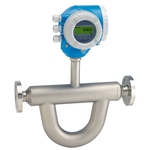
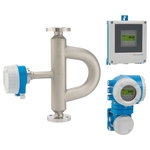
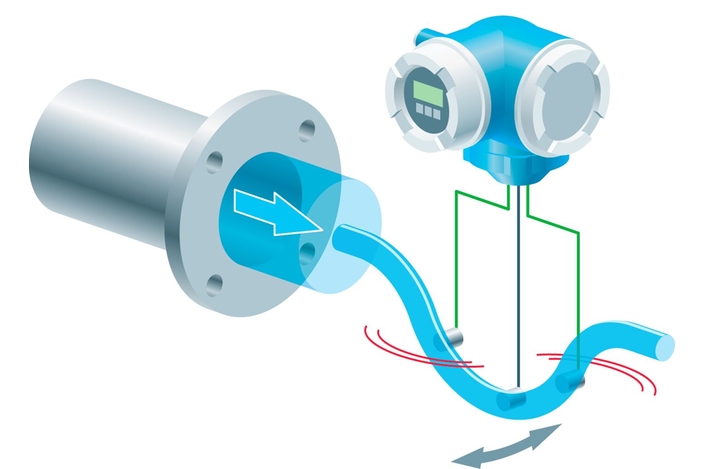
A Coriolis flowmeter works by oscillating one or more measuring tubes and sensing the deflection caused by the Coriolis effect as fluid moves through these tubes.

Inside view of a Coriolis mass flowmeter, showing driver, sensors and measuring tube.
This deflection is directly proportional to mass flow rate, so Coriolis flowmeters are able to measure true mass flow rather than the volumetric flow that most other meters rely on. This oscillation also allows the meter to determine fluid density, by tracking the tube’s resonance frequency. This direct, fundamental measurement principle is one reason why Coriolis flowmeters are widely used where high mass flow and density accuracy are required, with accuracies of ±0.1% or better achievable under reference conditions.

The effect of entrained gas on flowmeter readings
Entrained gas refers to the presence of small quantities of gas, typically in the form of bubbles, within a liquid flow that is otherwise expected to be single-phase. This is a well-studied and well-understood condition in Coriolis metering: when a second phase (e.g., gas) is introduced to the liquid being measured, it can change the tube’s deflective effect and resonance frequency. Without adaptation in the Coriolis-based measuring process, the liquid’s true mass reading could be adversely affected.
Understanding the effects of entrained gas on measurement accuracy and how to manage them begins with recognizing that entrained gas does not produce a single, predictable error. It could lead to two types of error mechanisms: the bubble effect and the resonator (compressibility) effect.
The bubble effect: free bubbles cause underreading
The bubble effect occurs when gas bubbles are large enough – or the surrounding liquid is not viscous enough, for the bubbles to behave independently of the liquid’s motion rather than moving with it. These are known as free bubbles.
Because gas is significantly less dense than the liquid carrying it, these free bubbles tend to slip relative to the tube wall during oscillation rather than following it precisely. This reduces the effective inertia that the tube senses, which causes the meter to underestimate mass flow rate as well as density. By contrast, suspended bubbles, which are smaller bubbles or bubbles that are held within more viscous liquids, tend to follow the liquid’s motion much more closely and do not produce a significant bubble effect.
This distinction matters, because suspended bubbles, not free bubbles, cause the second and more difficult problem: the resonator effect.
The resonator effect: suspended bubbles cause overreading
The resonator effect appears when small, well-suspended bubbles significantly reduce the speed of sound in the fluid mixture. This does not even require a large amount of entrained gas; a small proportion of tiny, suspended bubbles is enough to cause a large drop in the acoustic velocity of a fluid mixture.
This is significant because the resonator effect introduces errors into both mass flow and density measurements, not just one. Unlike free bubbles, suspended bubbles largely follow the liquid motion and therefore do not primarily reduce the effective inertia sensed by the meter. Instead, they lower the speed of sound in the fluid mixture, shifting the mixture’s acoustic resonance closer to the measuring tube’s mechanical driving frequency. This interaction distorts the tube’s vibrational response and can cause the meter to overestimate both mass flow rate and density.

Dependence of velocity of sound on gas void fraction and pressure: Sound velocity drops sharply with just small amounts of entrained gas.
Because suspended bubbles are much harder to separate from the liquid with conventional separation equipment than free bubbles, the resonator effect tends to be the dominant and more persistent problem encountered in the field. It is also more pronounced in meters with larger tube diameters, since a larger diameter lowers the acoustic resonance frequency of the tube-fluid system. This reduces the margin between the fluid’s resonance and the tube’s driving frequency, increasing interference if it is not compensated.
In processes where both free and suspended bubbles are simultaneously present, the two effects can partially offset each other at some moments and compound at others, depending on the actual bubble size distribution present at any given time. This is why entrained gas errors in the field often appear inconsistent, making them even harder to correct.
Where entrained gas comes from
Entrained gas can enter a process in several ways, and recognizing the source is the first step toward addressing it.
Outgassing is one common cause, where dissolved gas comes out of the solution as it moves from a high-pressure to a low-pressure section of a process. Insufficient liquid levels in upstream tanks can allow gas to be drawn into the suction line. Together, insufficient back pressure and low liquid level in tanks are the most common sources of gas entrainment.
Some fluids are simply more prone to carrying entrained gas because of their physical properties. High-viscosity fluids, such as heavy oils, tend to hold bubbles rather than allow them to separate and escape. Certain products, such as dairy fluids, naturally contain microbubbles as part of their composition or processing.
The practical distinction that matters here is that free bubbles, generated for example by turbulent mixing or aeration, tend to separate from the liquid relatively easily given the right conditions. Suspended bubbles, generated by outgassing or held in place by fluid viscosity, do not. This distinction determines what can realistically be achieved through process design alone, and what requires a different approach.
Gas removal at the source: the most effective response
Removing entrained gas before it reaches the meter is the most effective response and should be the first consideration in any process, especially if entrained gas is a known or suspected issue, since standard Coriolis flowmeter calibration cannot correct for these errors. The bubble effect and the resonator effect produce inconsistent, competing offsets rather than a stable deviation, leaving no fixed error to calibrate out.
Several practical, well-established measures can reduce or eliminate free bubbles at the source:
- Maintaining sufficient back pressure and minimizing pressure losses between the process and the meter inlet, to suppress outgassing and keep dissolved gas held within the solution
- Installing gas eliminators or settling tanks upstream of the meter, allowing larger bubbles time and space to separate from the liquid before measurement
- Ensuring adequate liquid levels in upstream tanks to prevent the pump from drawing in air or gas
- Avoiding top filling of tanks with free-fall drops, using bottom filling instead
- Increasing flow velocity or turbulence where practical, to help break larger free bubbles into smaller, more manageable sizes
- Installing meters in vertical position with the liquid flowing upwards (flag installation) to allow any transient free gas to leave the meter completely
- Using the smallest possible nominal size Coriolis meter to increase flow velocity in the measuring tubes and facilitate better mixing
In many applications, process and piping design optimizations are effective measures to keep entrained gas from affecting measurement. In others, however, some amounts of gas remain unavoidable.
What if gas cannot be removed?
In some applications, a degree of entrained gas is effectively unavoidable. In these cases, ongoing diagnostic visibility into gas presence and two-phase flow characteristics is rather valuable in its own right, supporting informed operational decisions and ultimately product quality. Proline Promass Coriolis flowmeters from Endress+Hauser provide this visibility through the Gas Fraction Handler (GFH) function.
The Gas Fraction Handler (GFH) function adapts signal processing to the actual process condition to improve measurement stability when entrained gas is present. Unlike static filters, GFH adjusts the level of damping applied to the output signal according to the severity of the disturbance detected. During stable single-phase operation it does not intervene, keeping the signal fast and dynamic. When a second phase such as entrained gas is detected, it applies targeted smoothing to stabilize measured values and improve repeatability without requiring operator intervention.
Besides measurement stability, GFH supports understanding what is happening inside the process. Through two dedicated diagnostic indexes, changing process conditions are evaluated and conclusions can be derived whether unstable measurements are related to gas bubbles, medium inhomogeneity or suspended microbubbles:
- The Medium Inhomogeneous Index (MI-MI) tracks the overall degree of medium inhomogeneity associated with free gas bubbles. A value of 0 indicates perfect single-phase flow, whereas 10 or higher indicates high gas content and process conditions similar to 10% gas void fraction (GVF). The index provides a relative, reproducible measure of gas-related disturbance that helps operators understand process conditions and track entrained gas levels over time.
- The Suspended Bubbles Index (MI-SB) provides additional diagnostic insight into the relative amount of suspended microbubbles in the medium, which are by nature too well-integrated into the liquid. In a viscous fluid they would be very hard to separate in a settling tank or gas eliminator, and too small to be broken up by increased turbulence in the way free bubbles can be.
While neither index provides a direct gas volume fraction measurement, both support faster root cause analysis, more reliable trend monitoring and better-informed process decisions through a qualitative and relative assessment of gas-related effects.
GFH helps stabilize measured values and identify gas-related disturbances. However, signal stabilization and diagnostics do not correct the measurement error itself. For that, the flowmeter needs additional measurement information provided by Multi-Frequency Technology (MFT).
Correcting the resonator effect through Multi-Frequency Technology
In processes involving outgassing, high-viscosity fluids or naturally microbubble-bearing products, suspended microbubbles may remain even after gas separation is applied in the process. In these cases, Multi-Frequency Technology offers a targeted way to compensate for the resonator effect, which is the most persistent of the two error mechanisms described above.
To understand why this compensation requires a different approach to measurement, it helps to look at why conventional Coriolis meters cannot do it. A conventional meter oscillates at a single frequency, the first natural mode of the measuring tube.
When entrained gas is present, the apparent density reading from this single mode is affected by the resonator effect, but the meter has no way of separating how much of that deviation is due to the true fluid density and how much is due to the acoustic resonance frequency of the gas-liquid mixture. With one measurement and two unknowns, the resonator effect error cannot be calculated.
MFT, available in Proline Promass Q flowmeters, resolves this by driving the measuring tube simultaneously at a second frequency: the third natural mode of the tube, which resonates at approximately five to six times the frequency of the first mode.

Modal shape of the first (A) and third (B) natural mode in numerical simulation.
Both modes are excited by the same driver and processed together by the device electronics. Because the two modes respond differently to the same entrained gas mixture, this produces two independent apparent density readings from the same fluid at the same moment. The result is two equations, two unknowns, both solvable. Once the acoustic resonance frequency of the mixture is known, the resonator effect error on both density and mass flow can be calculated and compensated in real time.
Beyond correcting the resonator effect, the additional measurement information generated by MFT can also support gas void fraction and water cut measurement, as shown in the validation examples below.
MFT in action: examples from food and beverage production
Unintended gas
In the food and beverage industry, one challenge is that at the start of milk collection runs, the trucks are only partially filled, so air is continuously churned into the product during the drive. At delivery and even after air separation, some residual air affects measurement. The small mass flow measurement percentage errors caused by this entrained air accumulate to significant financial discrepancies within a year, especially in large-scale operations like that of the German dairy Meierei Barmstedt. MFT reduces this measurement error to nearly zero at the point of delivery, enabling more accurate accounts settlement with dairy farmers and more reliable full-cost pricing across products.
Intentional gas
In some food and beverage applications, gas is a deliberate and quality-critical ingredient. The challenge here is not to remove the gas but to measure accurately in its presence. Conventional Coriolis meters struggle to do this with precision because the resonator effect distorts both density and mass flow readings, particularly when gas content varies widely across process conditions.
A frosting manufacturer encountered this problem directly: a conventional Coriolis meter installed for this application gave correct density readings but produced no flow indication at all. Entrained air at the process conditions rendered mass flow measurement unusable. Testing with Promass Q across a range of pressures and mixer speeds showed that air content in the frosting varied from under 1% at high pressure and high RPM to nearly 15% when the process was at rest. This kind of dynamic range makes a fixed correction factor unworkable, but it is precisely the condition MFT is designed for. By continuously characterizing the entrained air rather than assuming a fixed correction, Promass Q delivered reliable mass flow and density readings across the full range of process conditions.
A coffee and tea manufacturer provided the most direct accuracy comparison, measuring a highly viscous coffee extract at approximately −3 °C and viscosities ranging from 839 to 2505 cP, depending on concentration. A conventional meter installed in parallel read density at 1170 kg/m³ against a laboratory reference of 1100 kg/m³.This was a 6% error that the manufacturer was compensating for manually with a correction factor. Promass Q read 1104 kg/m³ under the same conditions: an error of 0.4%. The improvement was achieved not by modifying the process but by compensating for the resonator effect that the conventional meter had no means to address.
Proof from independent testing: from 2% error to 0.3%
MFT has been validated under realistic field conditions at two independent laboratories.
The Schlumberger facility in Porsgrunn, Norway, tested Proline Promass Q with MFT on nitrogen-saturated saline water under controlled outgassing conditions.
A reference Coriolis meter measured the fluid at high pressure, where it remained single-phase, while a test meter was installed in the low-pressure section, where outgassing generated a homogeneous microbubble flow regime.

Outgassing setup and corresponding schematics at Schlumberger for Promass Q with MFT, shown as device under test (DUT).
Test conditions spanned flow rates from 7000 to 18,000 kg/h at 50 °C, with GVFs reaching approximately 3%.
Without MFT, flow measurement error under these conditions reached up to 2%. With MFT, error was reduced to approximately 0.3% across the full range of test conditions, with no changes to the process itself.

Measurement accuracy as a function of GVF, with and without MFT.
At a separate laboratory, DNV GL, a second test evaluated MFT’s ability to accurately measure water cut (i.e., the proportion of water in an oil-water mixture) in the presence of entrained gas. The results confirmed water cut measurement accuracy in oil-water-gas conditions, under independently verified conditions.

Watercut measurements by MFT corrected with GVF, compared against reference values.
While these results reflect specific realistic test conditions rather than a universal performance guarantee, they offer a practical basis for evaluating whether MFT is relevant to a given process, particularly where outgassing or suspended microbubbles are a known challenge.
Key takeaways
- While Coriolis remains the most accurate mass flow measurement technology available, entrained gas is a known and well-studied condition that affects flow measurement under specific circumstances.
- Because two opposing mechanisms (i.e., the bubble effect and the resonator effect) can affect Coriolis-based measurements, entrained gas errors can be inconsistent and therefore harder to correct.
- Removing entrained gas at the process level is the most effective management response and should be the first consideration in any affected application.
- Where gas cannot be fully removed, the presence of gas is intentional or where its presence is unknown, GFH provides stabilized measured values and diagnostics, while MFT compensates specifically for the resonator effect; it is a targeted solution, not a universal fix.